Every few years, a new technology shows up promising to change the way businesses operate.
Cloud computing did it. Mobile apps did it. Workflow automation did it.
Now it's AI agents.
Open any business or tech publication and you will find someone claiming that AI agents are about to replace employees, automate entire departments, and rewrite how companies operate. Some of that is genuine. A lot of it is noise.
We build automation and AI systems for B2B companies at Altreonix, so we end up on both sides of this conversation a lot. We talk to founders who are convinced they need an AI agent for everything, and we talk to founders who have a real, well defined problem that an AI agent would solve in a week. The difference between the two almost always comes down to one thing: whether anyone asked the right questions before writing a single line of code.
So before you invest on an "AI agent," it's worth pausing on a more useful question.
Does your business actually need one?
Here are seven questions that will give you a clearer answer than any sales pitch will.
First, What Is an AI Agent, Actually?
An AI agent is a software system that can understand information, make a decision, and take an action toward a goal, without a human walking it through every step.
That's different from traditional automation, which follows a fixed set of rules. Traditional automation is reliable and predictable, but it only does what it was explicitly told to do.
Here's the difference in practice. Traditional automation might send a confirmation email the moment a customer submits a form. An AI agent could instead read the customer's message, work out what they actually need, pull up relevant account information, draft a personalized reply, and flag the few cases that genuinely need a human, all without anyone writing a rule for every possible scenario.
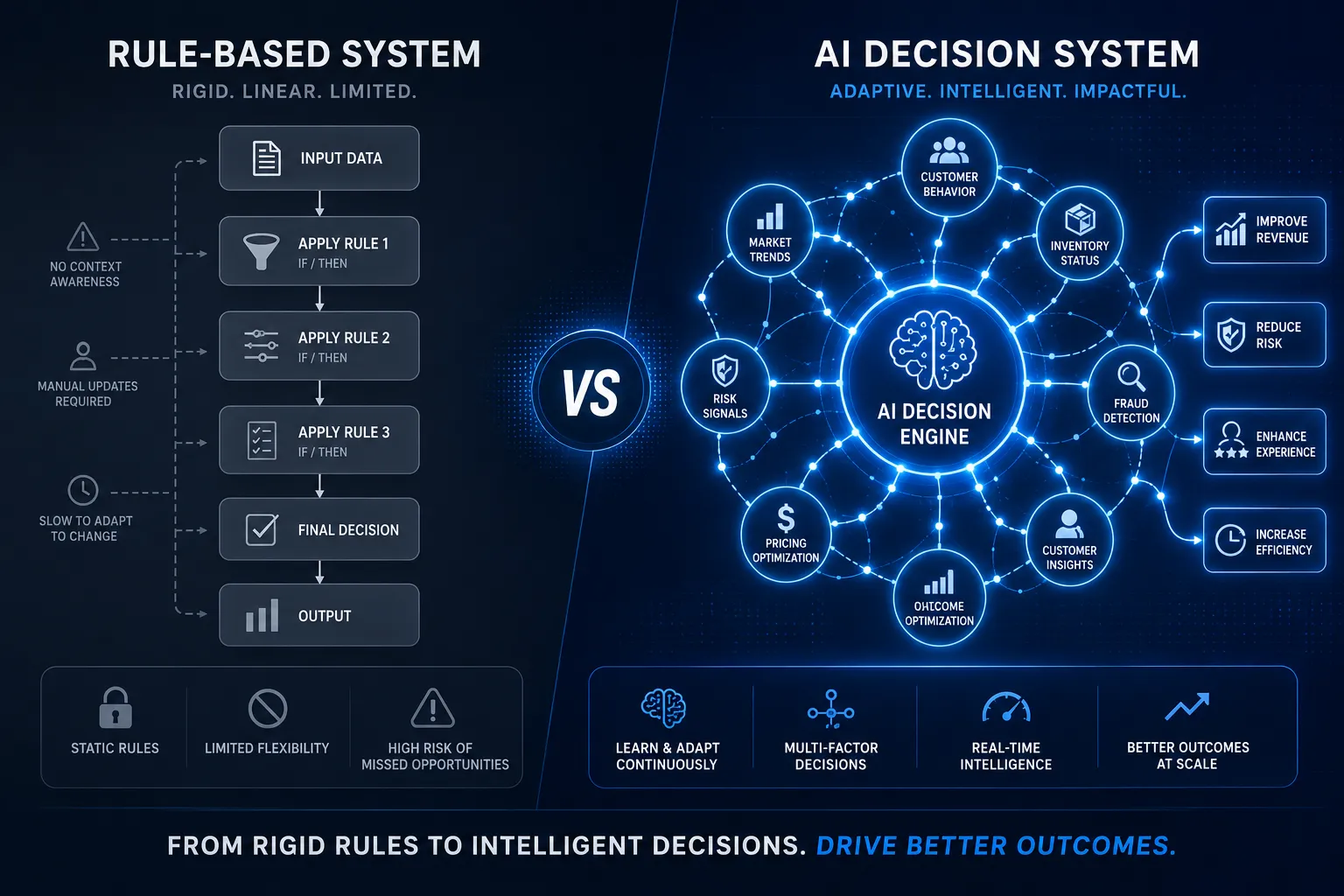
That's the appeal. AI agents are useful exactly where judgment, context, or variation is involved, and traditional automation starts to strain.
It's also why the technology is moving fast. Gartner expects 40% of enterprise applications to ship with task specific AI agents built in by the end of 2026, up from under 5% in 2025. That is one of the steepest enterprise software adoption curves on record, faster than the early cloud computing shift. But the same research firm also expects more than 40% of agentic AI projects to be cancelled by 2027, mostly because companies adopted the technology before they had a clear problem to point it at.
That second number matters just as much as the first one. It's the reason this article exists.
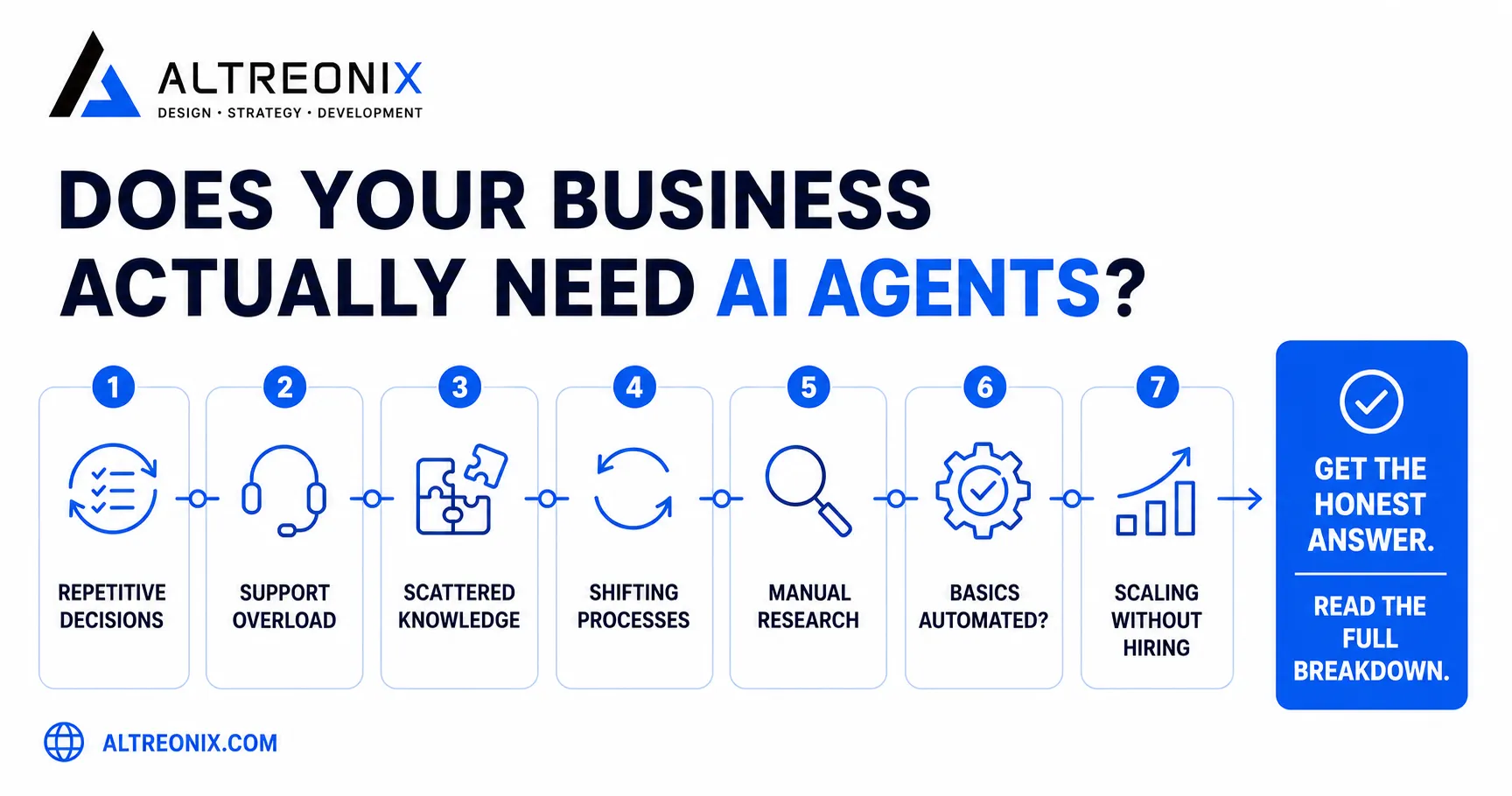
1. Are Your Employees Repeating the Same Decisions Every Day?
Most businesses have processes that require someone to make a similar judgment call, over and over, all day.
Common examples:
Categorizing incoming customer inquiries
Routing support tickets to the right team
Reviewing and qualifying inbound leads
Approving routine internal requests
Answering the same handful of questions
When a person spends hours a week making decisions that follow a recognizable pattern, that's usually a sign an AI agent could take on a meaningful chunk of the work.
The point is not to remove the person from the loop. It's to stop them from spending their best hours on decisions a system can make just as well, so they can spend that time on the work only a human can do.
Ask yourself: Do your employees spend significant time reviewing information and making decisions that follow a predictable pattern? If yes, this is one of the clearer signals that an AI agent will earn its cost.
2. Is Customer Support Quietly Eating Your Team's Day?
Customers expect a fast answer regardless of what time it is or whether your office is open.
Most support teams lose a surprising amount of time to the same small set of questions:
"Where's my order?"
Appointment scheduling and rescheduling
Product and pricing questions
Service availability
Basic troubleshooting
An AI agent can handle a large share of this on its own, around the clock, and hand off the genuinely complicated cases to a human who actually needs to be involved. That gets you faster response times without forcing you to hire ahead of demand.
Ask yourself: Are your support staff answering the same questions week after week? If so, this is usually the fastest payback area for AI agents, because the questions are repetitive and the volume is high.
3. Is Your Business Knowledge Scattered Across a Dozen Tools?
Most companies accumulate information in more places than anyone planned for:
Emails
Shared drives and documents
Internal databases
CRM systems
Project management tools
Separate knowledge bases
The result is almost always the same. People spend more time hunting for information than acting on it.
An AI agent can sit across these systems and answer questions directly, instead of someone manually checking five different tools. Rather than asking "where is that stored," your team can simply ask "what's the latest project status for this client," and get an answer pulled from wherever it actually lives.
Ask yourself: How much time does your team lose to searching before they can even start the actual work? If the honest answer is "more than we'd like to admit," this is worth solving.
4. Do Your Processes Change Faster Than You Can Document Them?
Traditional automation works best when a workflow stays still long enough to be mapped out and built. Plenty of businesses don't have that luxury.
Processes that tend to shift often:
Marketing campaigns
Sales workflows
Client onboarding
Internal approvals
Service delivery steps
When a workflow changes every quarter, or every month, maintaining rigid automation becomes its own ongoing project. Every change means going back into the rules and rebuilding part of the system.
AI agents handle this better because they work toward a goal rather than following a fixed sequence of steps. That makes them more resilient when the underlying process shifts under them.
Ask yourself: Do your workflows need frequent rework because the business itself keeps changing? If yes, an AI agent will likely hold up better than a rigid automation built around today's process.
5. Is Manual Research Slowing Down Every Decision You Make?
A lot of business activity is really just preparation before a decision gets made:
Reviewing a customer's history before a call
Comparing vendor proposals
Researching competitors
Reading through support tickets for patterns
Pulling together a report
Individually, none of these take long. Across a week, they add up to hours that never show up on anyone's calendar as "real work."
An AI agent can gather, summarize, and organize this kind of information far faster than a person can, which shortens the distance between "we need to decide" and "we decided." It doesn't remove human judgment from the decision. It just removes the slow part that came before it.
Ask yourself: How many hours does your team lose to gathering information before they can actually start? If that number is bigger than you'd like, this is a strong candidate for AI agents.
6. Have You Actually Automated the Basics Yet?
This is the question most businesses skip, and it's the one that matters most.
A lot of companies jump straight to AI before fixing the fundamentals:
Form submissions that still require manual follow up
CRM workflows with gaps in them
Email sequences that don't trigger reliably
Lead routing that depends on someone remembering to check
Data that has to be re-entered between systems
Reports that get built by hand every week
If these basics are still manual, plain automation will almost always get you a faster, cheaper win than an AI agent will. AI agents perform best when they sit on top of a process that's already clean and well structured, not when they're being asked to compensate for one that isn't.
This is also where a lot of the AI project failures Gartner and others have flagged actually come from. The agent wasn't the problem. The process underneath it was never solid to begin with.
Ask yourself: Have you already cleared out the obvious manual work in your business? If not, start there. It's usually faster, and it sets you up to get far more out of an AI agent later.
7. Are You Trying to Move Faster Without Hiring Faster?
Growth puts pressure on operations whether you're ready for it or not.
As inquiries, requests, and overall complexity climb, most businesses face a version of the same choice: hire more people, push the existing team harder, or find a way to operate more efficiently with the team they already have.
AI agents are one of the more practical ways to scale decision-making without scaling headcount at the same rate. In practice, that shows up in places like:
Lead qualification
Support ticket triage
Internal knowledge lookups
Coordinating multi-step workflows
Pulling insight out of operational data
For a growing business, that difference compounds. The companies adopting agentic AI fastest right now skew toward mid-market and smaller organizations rather than large enterprises, mainly because the tools have gotten accessible enough that you no longer need an enterprise IT budget to use them well.
Ask yourself: Is growth creating more decisions than your current team can comfortably keep up with? If yes, this is the gap AI agents are usually built to close.
When AI Agents Are Probably Not the Right Call
Despite everything above, AI agents aren't the right fit for every situation. You're probably better off without one if:
Your processes are highly predictable and rarely change
Most of the work involved is simple and repetitive
Plain automation would solve the actual problem
You don't yet have clear documentation of how the process works today
In any of these cases, fixing or tightening what you already have will usually get you further, faster, and for less money than building an AI agent around it.
The Best Setup Is Usually Both, Not One or the Other
A lot of business owners frame this as a choice between traditional automation and AI agents. In practice, the strongest systems use both, each doing what it's actually good at.
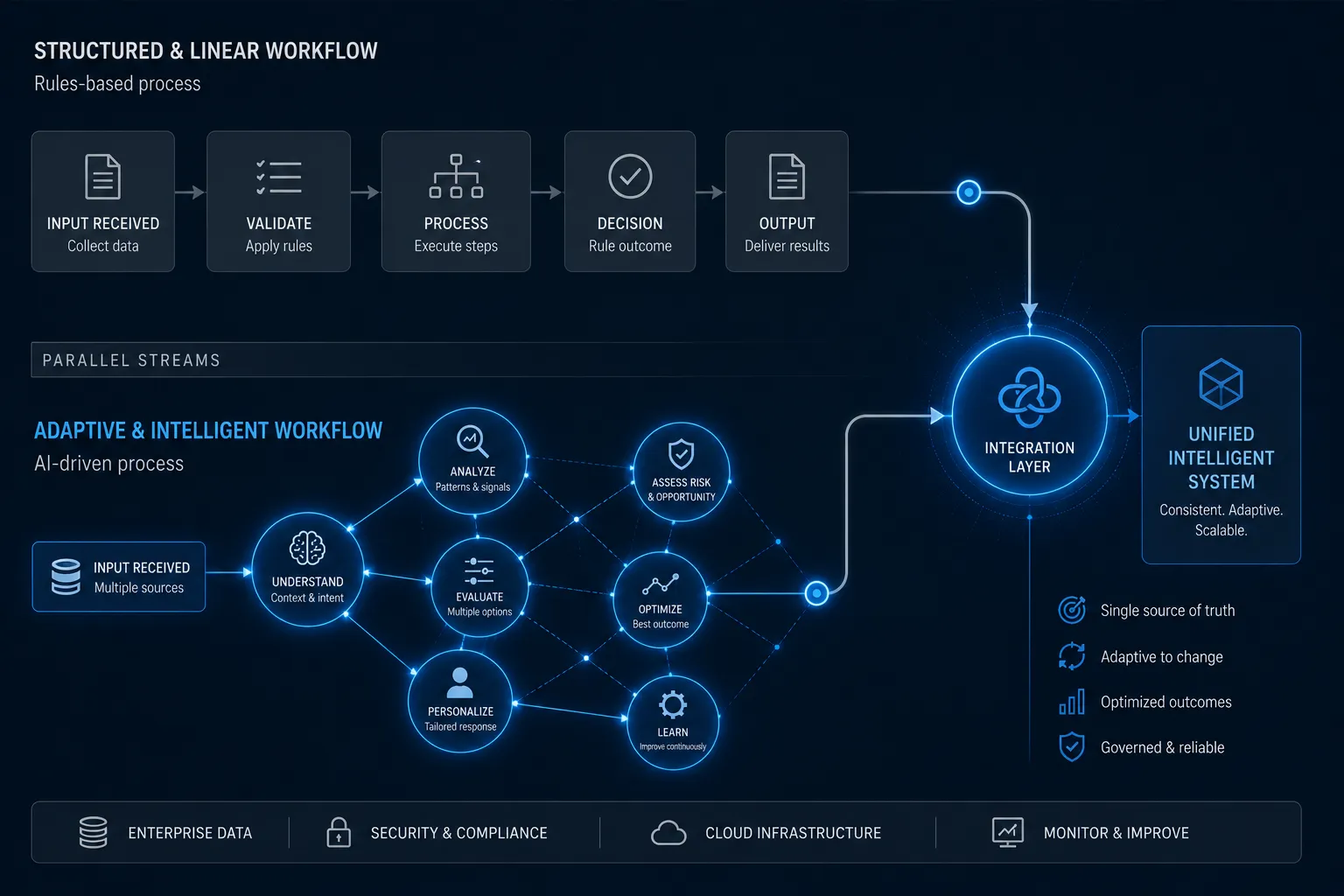
Traditional automation is the right tool for:
Repetitive, well defined workflows
Moving data between systems
Scheduled, recurring tasks
Connecting tools that need to talk to each other
AI agents are the right tool for:
Analysis and judgment calls
Decision-making that depends on context
Drafting content or responses
Finding information across scattered systems
Handling the exceptions that don't fit a standard rule
Put together, you get a system that's both efficient on the routine work and adaptable on everything else.
Final Thoughts
AI agents are genuinely useful. They are not magic, and they are not a substitute for a business that doesn't yet know what its own process looks like.
The companies getting real value out of AI agents right now aren't the ones chasing the term. They're the ones who looked closely at where time and money were actually leaking out of the business, then matched the right technology to that specific problem. Sometimes that's an AI agent. Sometimes it's automation. Often, it's both, layered properly.
If your team is stuck on repetitive decisions, drowning in scattered information, stretched thin on support, or trying to grow without growing headcount at the same pace, an AI agent is worth a serious look. If you're still running the basics manually, fix that first. It will save you money either way.
Want a Second Opinion Before You Spend on AI?
If you're trying to work out whether your business needs AI agents, automation, or a proper system to run on, the fastest way to know is to map your actual workflows and see where the time, money, and effort are really going. That's the part most companies skip, and it's the part that decides whether the technology pays off.
At Altreonix, this is the work we do for B2B companies every day, building AI solutions and automation workflows that are scoped to a real problem rather than a trend. If you want a clear, honest read on where your business actually stands, get in touch and we'll tell you straight, whether that means AI agents, simpler automation, or a mix of both.