Introduction
In our pillar post on no-code versus custom software, we laid out the broad case for why businesses eventually outgrow platforms like Bubble, Airtable, Glide, Softr, and Webflow. This post is the practical follow-up. Instead of the big picture, we’re walking through the specific, checkable signals that tell you where your business actually stands right now.
None of these signals mean panic and rebuild everything tomorrow. Some businesses will read this and confirm they’re genuinely fine where they are. Others will recognize two or three signals they’ve been quietly ignoring for months. Either answer is useful. What isn’t useful is not checking at all.
Signal 1: Your Platform Bill Keeps Climbing Faster Than Your Revenue
No-code platforms price on usage, records, seats, API calls, workflow actions, not on flat infrastructure. That means your bill is directly tied to your growth in a way that traditional hosting usually isn’t.
The check here is simple. Pull your platform invoices from the last twelve months and compare the growth rate against your revenue growth over the same period. If your Bubble workload unit costs, your Airtable seat count, or your Softr app user tier have climbed noticeably faster than your revenue line, that’s not a one-off, it’s the pricing model doing exactly what it’s designed to do as you scale.
A real example is worth keeping in mind here. One documented migration case involved a business whose full no-code stack, Bubble plus Xano, Memberstack, Zapier, Twilio, and SendGrid, added up to over $2,500 a month once every tool was counted, not just the core platform’s own line item. That’s the kind of total that rarely shows up clearly until someone adds it all up in one place.
Signal 2: You’re Getting Close to a Record or Row Limit
This one has an actual number attached to it, which makes it easier to check than most.
Airtable’s plan documentation caps bases at 50,000 records on Team, 125,000 on Business, and 500,000 or more on Enterprise Scale. Glide caps data at 25,000 rows on Free and Explorer, 50,000 on Maker, and 100,000 on Business, with anything larger pushed into a separate high scale data source. Softr allows up to 500,000 records on Professional and up to 1 million on Business, but also gates on named app users, 100 on Professional and 500 to 1,000 on Business.
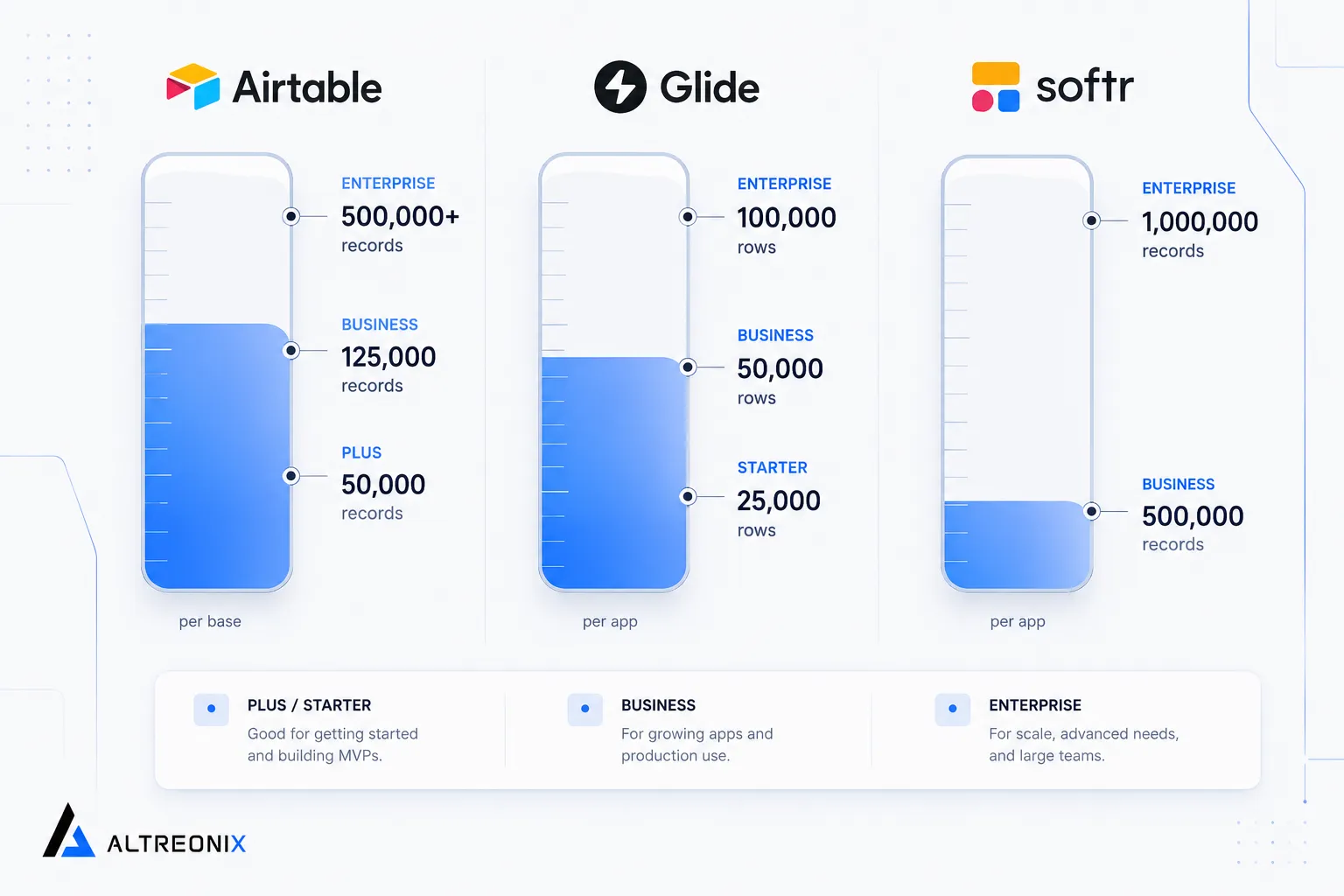 The practical check is to look at your current record count as a percentage of your plan’s cap, and then look at your growth rate. If you’re above 70 to 80% of your limit and still growing, the next forced upgrade isn’t a maybe, it’s a matter of a few months. That’s worth planning around rather than discovering the day an import fails.
Signal 3: Your Workflows Depend on More Integrations Than Logic
No-code workflow engines handle common patterns well. Once your business logic branches into enough conditional paths and exceptions, teams commonly patch the gaps with Zapier, Make, or similar tools bolted on around the core platform.
Veld Systems’ migration guide describes real client stacks running fifteen or more Zapier integrations stitched between Airtable, Bubble, and Mailchimp, where a failure anywhere in that chain breaks the whole workflow. The check here isn’t just counting integrations, it’s asking what happens when one of them fails silently. If your team has a running list of “things that sometimes just stop working and someone has to manually fix it,” that list is your actual signal, regardless of how many integrations technically exist.
Signal 4: Performance Is Degrading and You Can’t Fix It Yourself
This signal is less about a specific number and more about a specific feeling: watching load times creep up and having no lever to pull.
Veld Systems notes that Bubble apps under real load commonly see load times climb past five seconds, with no ability to optimize queries or add caching at the infrastructure level, because that layer simply isn’t exposed to the builder. If your team has ever said “we know it’s slow, but there’s nothing we can do about it from our end,” that’s the signal. On a custom stack, a slow query is a bug you fix. On a no-code platform past a certain point, it’s a ceiling you wait out.
Signal 5: A Client, Partner, or Regulator Has Asked About Compliance You Can’t Confirm
This is the signal most likely to arrive without warning, usually in the middle of a sales conversation or a partnership deal.
Bubble’s own infrastructure and compliance documentation confirms SOC 2 Type II and GDPR support, but Bubble does not sign HIPAA Business Associate Agreements, which rules it out for apps that need to be formally HIPAA-compliant without significant architectural workarounds. If you’ve ever had to answer “can you confirm X certification” with “let us get back to you,” and the honest answer turned out to be no, that’s not a paperwork gap. It’s a hard blocker with real revenue attached to it.
Signal 6: You’ve Quietly Stopped Building Certain Features
This is the hardest signal to notice, because it doesn’t look like a problem, it looks like a decision.
Watch for the pattern where a feature request comes up, gets discussed, and then gets shelved with some version of “the platform makes that too hard.” If that’s happened more than once in the last few months, your roadmap is being shaped by the platform’s limits rather than by what your business actually needs. That’s a quiet version of the same ceiling the louder signals point to.
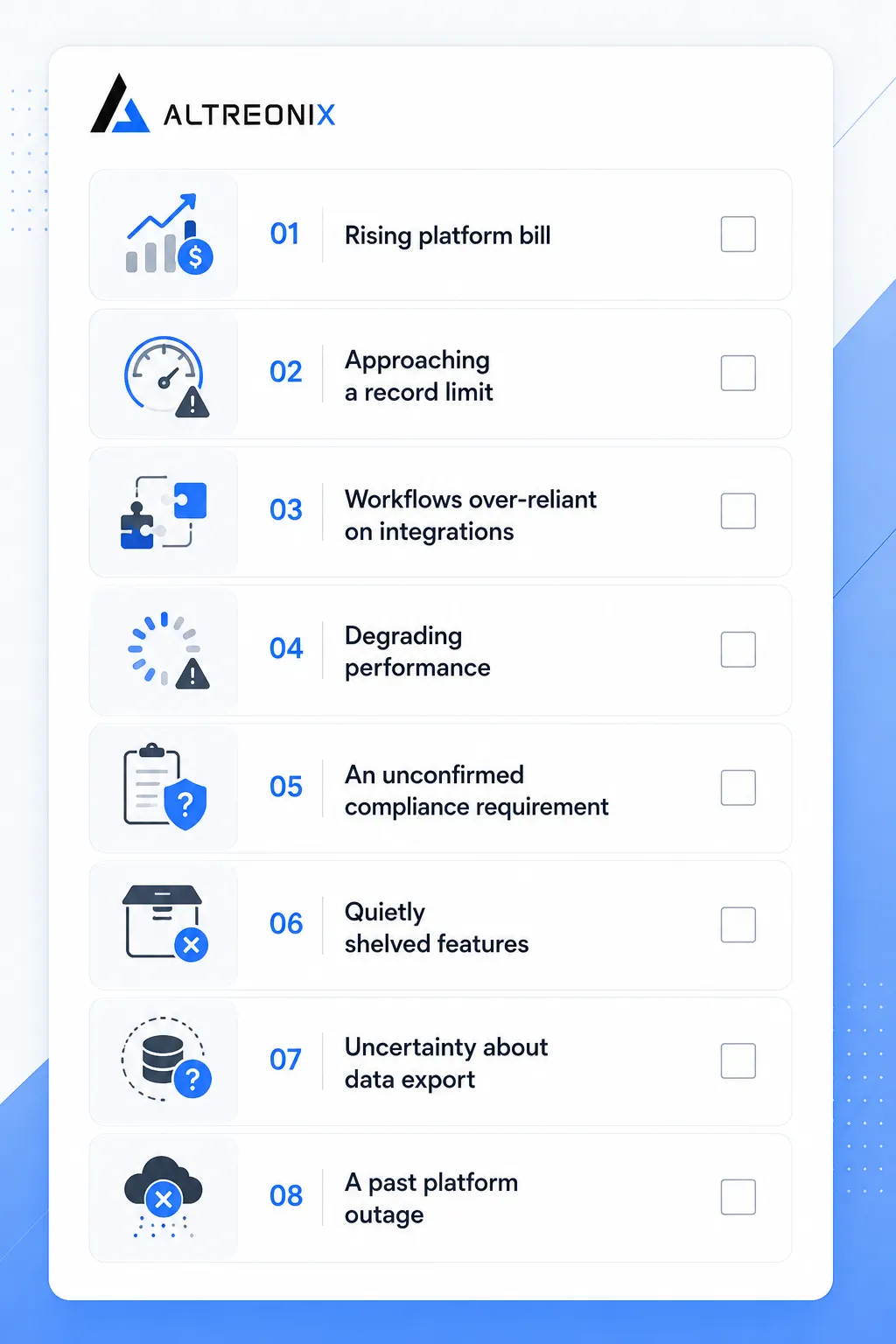 ## Signal 7: You’ve Wondered What Happens If You Ever Need to Leave, and Didn’t Like the Answer
Bubble is explicit about this in its own documentation and community forum. Bubble apps cannot be exported as runnable source code, only the underlying data can be exported, which means the actual application logic, workflows, and interface would need to be rebuilt from scratch if you ever left the platform. Independent breakdowns from sources like BubbleXport and BKND Development reach the same conclusion, describing Bubble’s export options as sufficient for a backup but not for a real migration path.
If you’ve never actually asked this question about your own stack, it’s worth asking now, while it’s a hypothetical, rather than later, when it’s an urgent one.
Signal 8: You’ve Already Had an Outage That Took Your Business Down With It
This is the signal that turns an abstract risk into a lived experience. Webflow’s own incident history includes an outage where a database cluster hit an undocumented capacity limit, taking dashboards, hosted sites, and APIs offline for a portion of customers for most of a business day. Bubble has had a comparable incident too, with an outage postmortem describing an AWS-forced database upgrade that caused editor downtime and lost unsaved changes during a multi-hour window.
If your business has already lived through one of these, even a minor one, that’s a data point, not bad luck. It’s a preview of what depending entirely on someone else’s infrastructure actually feels like when it goes wrong.
What to Actually Do With This
Checking these signals is only useful if it leads somewhere. Here’s how we’d think about next steps, matched to what you find.
| If you’re seeing | A reasonable next step |
|---|---|
| One or two cost or performance signals, nothing urgent | Keep monitoring quarterly, no action needed yet |
| Three or more signals, including a compliance or data limit signal | Start scoping what a migration would actually involve, even if you’re not ready to commit |
| A compliance blocker tied to real revenue, or a recent outage that hurt the business | Treat this as active, not exploratory, the cost of waiting is already showing up |
Not every business that recognizes a signal or two needs to migrate immediately. We covered the honest counter-case, situations where staying on no-code is genuinely the right long-term call, in our pillar post. The point of this checklist isn’t to push everyone toward a rebuild, it’s to replace a vague feeling of “this is getting harder” with something concrete enough to actually act on, or confidently set aside.
How We Think About This at Altreonix
When a business comes to us wondering whether it’s time to move off a no-code stack, the first thing we do is walk through exactly the signals above with real numbers from their own account, not assumptions. Our Web Applications and Business Systems work starts there, because the honest answer is sometimes “not yet,” and we’d rather tell you that than sell you a rebuild you don’t need.
If you’ve recognized a few of these signals in your own stack, that’s a reasonable place to start a conversation with us.