Introduction
This series has spent a lot of time on when Bubble, Airtable, Glide, Softr, and Webflow stop being enough, the signals to watch for, what actually breaks technically, what it costs, and how to migrate off them without a disaster. This post is the other half of that argument, and it deserves just as much weight. For a real, meaningful share of businesses, no-code isn’t a phase to outgrow. It’s the correct architecture, indefinitely.
We think this needs saying plainly, because a series built around “know when to leave” can accidentally read as “you’ll eventually need to leave.” That’s not true, and we don’t want to leave that impression.
The Businesses No-Code Was Actually Built For
No-code tools solve a real problem well: getting a working piece of software into use quickly, without hiring a development team, for situations where the complexity and scale stay within a predictable range. Internal tools used by a handful of employees. Departmental workflows that automate something a spreadsheet used to handle manually. Customer portals with a bounded, slow-growing user base. Content sites and marketing pages, which is exactly what a platform like Webflow was originally built to do well, and continues to do well indefinitely for businesses that aren’t trying to build an application on top of it.
Adoption data backs up how common this category actually is. Industry research on small business technology adoption shows a large majority of small businesses with under 50 employees now use no-code tools for workflow automation, and a meaningful share of them report measurable revenue gains within a year of adopting them. That’s not a statistic about businesses on their way to a migration. That’s a statistic about businesses where no-code is simply working, as intended, at the scale it was designed for.
There’s a useful pattern hiding inside that adoption data too. The businesses reporting the strongest, most durable results tend to share a specific trait: their usage is predictable. A departmental workflow automating expense approvals doesn’t suddenly need to handle ten times the volume next quarter. A customer portal serving a fixed client base doesn’t experience the same kind of compounding growth pressure a consumer app chasing viral adoption does. Predictability, more than size alone, is the real variable that determines whether a no-code platform stays comfortable indefinitely.
Real Businesses Running Entirely on No-Code, Long Term
It’s worth naming real examples rather than leaving this abstract. Bubble’s own published case study catalog includes a vertical SaaS company that raised a three million dollar seed round and reached seven hundred thousand dollars in annual recurring revenue, serving thirty thousand daily active users, built entirely on Bubble. That’s not a small hobby project. That’s a funded, revenue-generating business making a deliberate, ongoing choice to stay on a no-code platform because it continues to serve the business well.
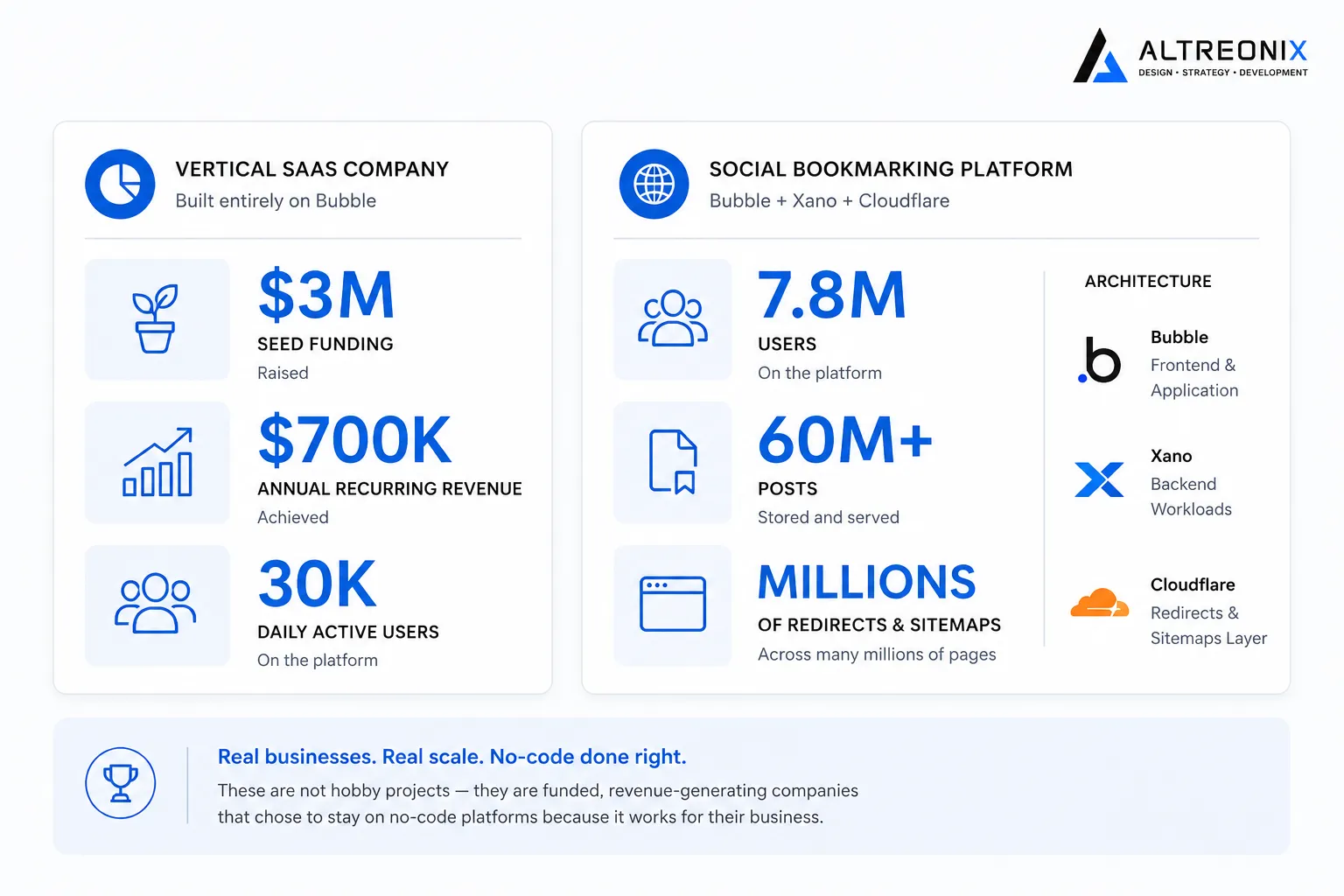 An even more striking example involves scale most people would assume requires custom infrastructure. A documented case describes a social bookmarking platform with 7.8 million users and around 60 million posts, running on Bubble paired thoughtfully with Xano handling backend workloads and a custom Cloudflare layer managing redirects and sitemaps. That combination successfully handled millions of redirects and sitemaps spanning many millions of pages. The lesson isn’t that Bubble alone scales infinitely, it’s that no-code, paired with the right supporting architecture at the layers where it genuinely struggles, can support far more scale than the “no-code doesn’t scale” shorthand suggests.
You Might Be Hitting a Skill Ceiling, Not a Platform Ceiling
This is worth sitting with honestly, because it cuts against the instinct to blame the tool. An audit-based analysis of over three hundred production Bubble apps, conducted in early 2026, found that a meaningful share of founders who believed they’d outgrown Bubble were actually running into problems caused by how their app was originally built, not a genuine platform ceiling. Apps rebuilt correctly inside Bubble, addressing inefficient searches, unnecessary nested lookups, and oversized lists rendering every row at once, often performed well without any migration at all.
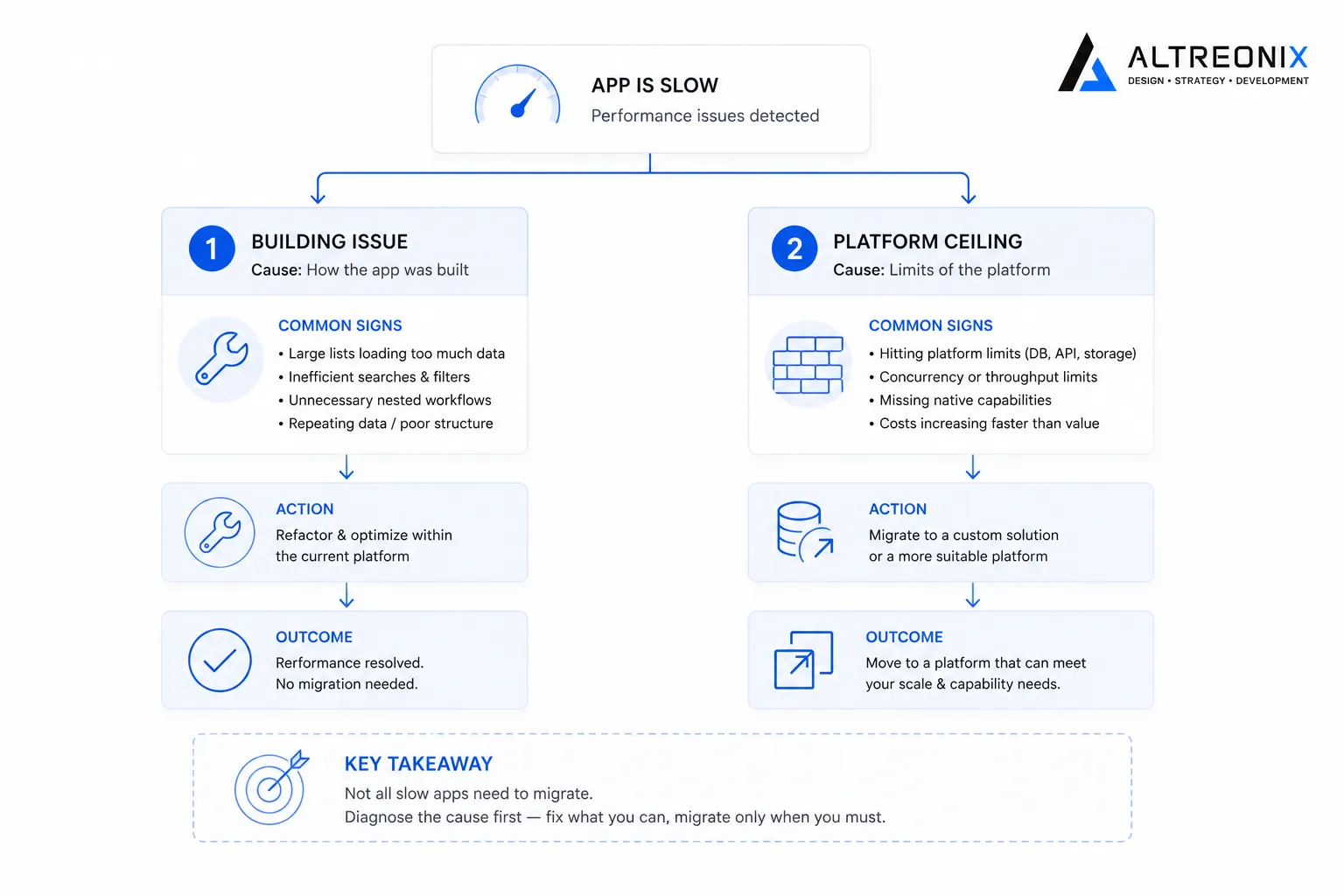 We covered these specific technical mechanisms in detail in our post on what actually breaks at scale, and the honest reading of that post cuts both ways. Some of what looks like “Bubble can’t handle this” is genuinely a hard platform ceiling. A meaningful amount of it is a fixable building mistake wearing a platform ceiling’s clothing. The two look identical from the outside, which is exactly why it’s worth getting a real technical opinion before assuming a migration is the only path forward.
When the ROI Math Genuinely Favors Staying
Independent research on low-code and no-code adoption backs up that this isn’t just a defensive argument. A Forrester Total Economic Impact study of Microsoft’s Power Apps platform found a composite organization realizing a 206% three-year return on investment. We covered the honest caveats around vendor-commissioned studies like this one in our cost comparison post, but the underlying pattern holds regardless of the exact percentage: for internal tools and departmental workflows with usage that stays within a platform’s comfortable range, the return on staying is real and durable, not just a temporary convenience before an inevitable rebuild.
There’s a simpler, more practical version of this same argument worth naming directly. Migration has a real cost, both in money and in the attention of whoever leads the effort. If your product is still evolving quickly enough that its shape might change significantly in the next year, if your current performance or cost problems are solvable through better optimization rather than a platform ceiling, or if the capital a migration would consume is more urgently needed for sales, marketing, or hiring, staying on no-code isn’t a compromise. It’s the financially disciplined choice.
A Quick Self-Check: Are You Actually in the “Stay” Category
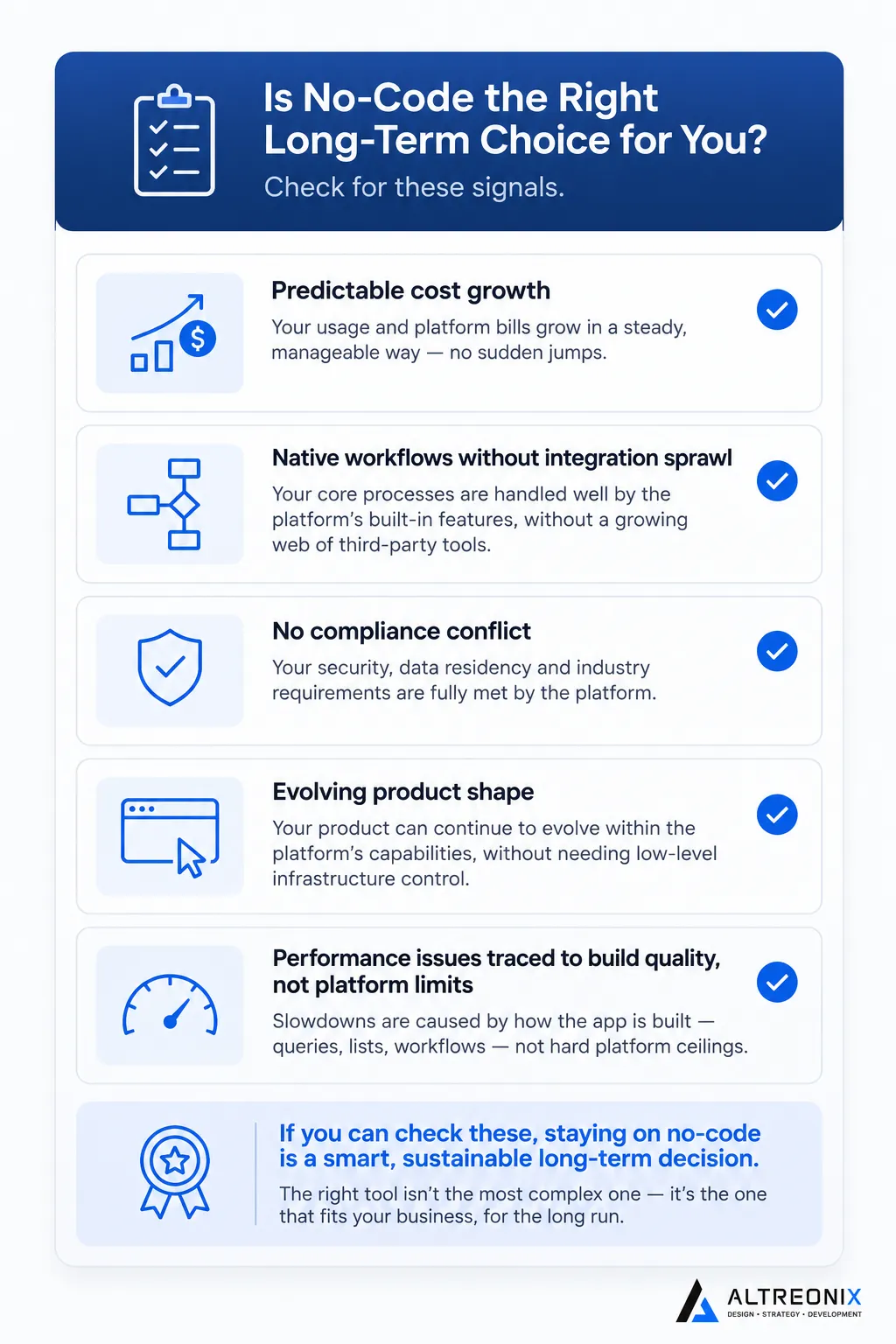
Our diagnostic post on signs you’ve outgrown Bubble, Airtable, or Webflow covers the opposite side of this question in detail. Here’s the inverse version, a quick way to check whether you’re genuinely in the category this post is about.
| If this describes you | You’re likely in the “stay” category |
|---|---|
| Your platform costs track predictably with your growth, not faster than it | Yes |
| Your workflows run on the platform’s native logic, without a growing pile of stitched-together integrations | Yes |
| You have no current or foreseeable compliance requirement the platform can’t meet | Yes |
| Your product’s core structure is still likely to change meaningfully in the next year | Yes |
| Performance issues you’ve noticed trace back to how the app was built, not a hard platform limit | Yes |
If most of these describe your situation, the honest answer is that a migration would be solving a problem you don’t actually have yet, and possibly one you’ll never have.
 ## The Honest Bottom Line for This Series
Across this whole series, we’ve made the case for recognizing real ceilings when your business actually hits them. This post is the other half of that same honesty. No-code isn’t a training-wheels phase every serious business eventually removes. For a real share of businesses, it’s simply the right architecture, indefinitely, and recognizing that clearly is just as valuable as recognizing the opposite.
How We Think About This at Altreonix
When a business comes to us assuming they need a custom rebuild, one of the more common outcomes of our initial audit is telling them they don’t, at least not yet. Our Web Applications and Business Systems work starts with an honest diagnosis of whether a platform ceiling is real or whether a build issue is masquerading as one, because recommending a migration a business doesn’t need isn’t good business for anyone, including us.
If you’re not sure which category you’re in, that’s a reasonable place to start a conversation with us.