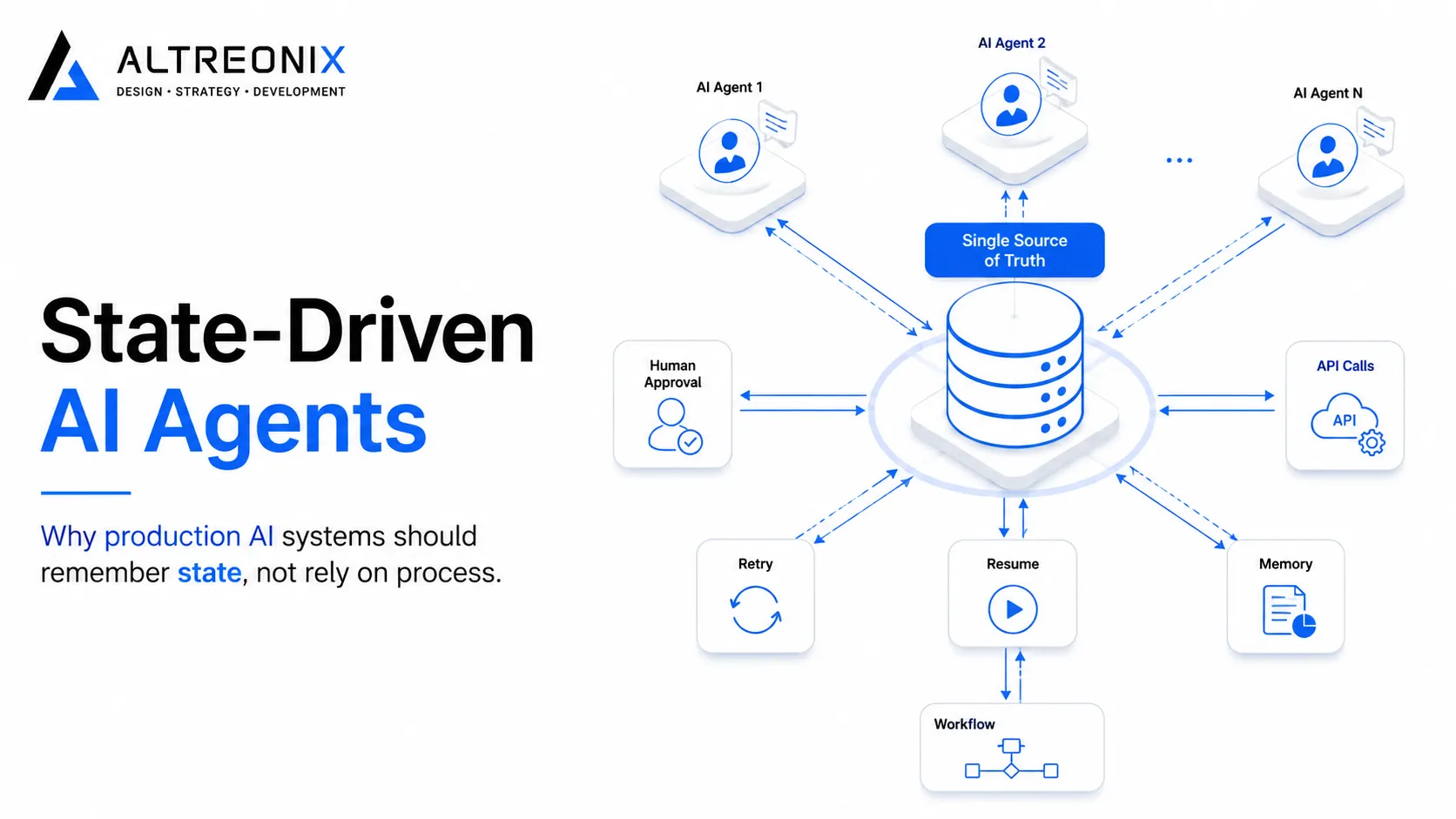
Introduction
Most discussions about AI agents focus on the wrong thing.
People debate which model to use, how to write better prompts, which tools to attach, and which planning loop to run. Those decisions matter. But they are rarely what causes a production system to break.
What actually breaks production is simpler and harder to fix: the agent forgets what happened, cannot recover from a failure, has no clean way to wait for a human decision, and cannot tell anyone what it is currently doing.
At Altreonix, we have one word for all of those problems: continuity.
This post makes the case that the architecture of an AI agent should be built around state, not around the assumption that the agent will always be alive and always remember what it was doing. We will look at why that assumption fails, how leading frameworks like LangGraph, the OpenAI Agents SDK, and AutoGen have responded to this reality, and what a better design looks like in practice.
This builds directly on our earlier post on event-based automation versus CRUD-based automation. That piece explained the difference between systems that react to events and systems that manage stored state. This one takes that same logic into AI agents, where the need for durable state is even more urgent because tasks span multiple steps, pauses, and human decisions.
The Mental Model Most People Use (and Why It Fails)
The most common way people describe AI agents is as a persistent, thinking entity. It reads context, decides what to do, calls tools, and keeps reasoning until the job is done. In a demo, that picture is accurate enough.
In production, it is a liability.
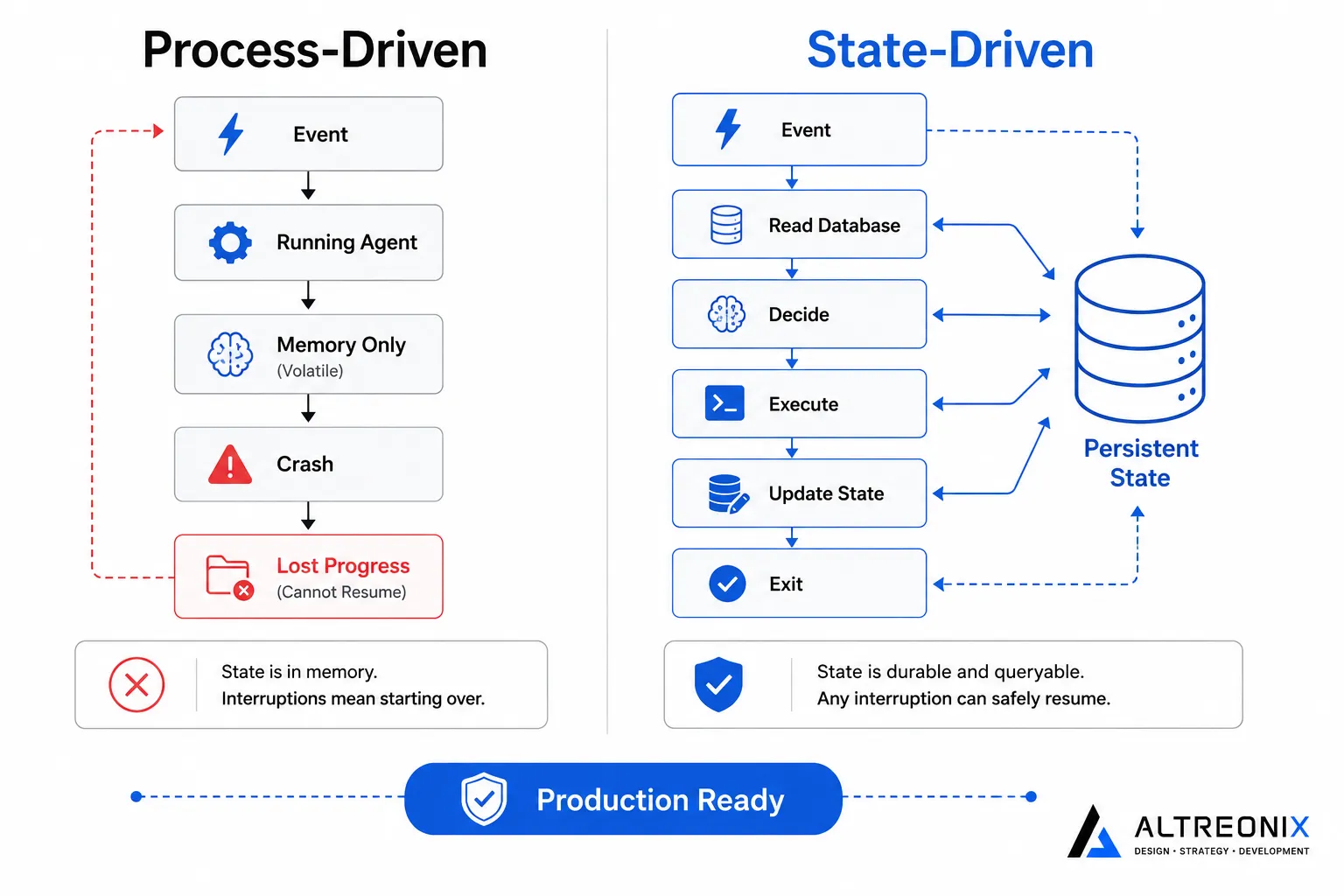
Real systems restart. Workers crash. API calls time out. A human needs to approve something and logs off for the day. The task gets deprioritized and needs to resume three hours later. If the architecture assumes the agent is always alive and always remembers what it was doing, the first interruption exposes how fragile that assumption is.
The problem is not intelligence. Modern language models can reason across complex tasks without much trouble. The problem is that intelligence without continuity is useless in a multi-step workflow. An agent that cannot resume from where it stopped is not a production system. It is a demo.
The fix is not to make the agent smarter. The fix is to stop building around the assumption of an always-alive process and start building around durable, queryable state.
The Better Model: State Over Motion
A production AI agent is better understood as a stateful workflow that can be reconstructed at any point in time.
This is not a niche opinion. It is the direction the major frameworks have moved.
LangGraph describes itself as a low-level orchestration framework built for durable execution, streaming, human-in-the-loop workflows, and persistence. The framework provides two complementary persistence systems. Checkpointers persist a thread's graph state and are used for short-term, thread-scoped memory, including conversation continuity, human-in-the-loop workflows, and fault tolerance. Stores persist application-defined data outside the graph state and are used for long-term, cross-thread memory including user preferences, facts, and shared knowledge.
The OpenAI Agents SDK makes the same architectural bet. RunState is the durable pause/resume boundary for human-in-the-loop flows. It stores enough information to continue an interrupted run, including model responses, generated items, approval state, and optional server-managed conversation identifiers.
Microsoft's AutoGen takes the same approach at the agent and team level. You can get the state of a team by calling save_state on the team and load it back by calling load_state. When you call save_state on a team, it saves the state of all the agents in the team.
None of these are convenience features bolted on after the fact. They are core infrastructure. The frameworks built them because production systems demand them.
What a State-Driven Agent Actually Is
A state-driven agent does not need to stay alive forever. It needs to do four things reliably, in order, every time it runs.
Read the current state. Before doing anything, the agent reads the stored record that describes where the task currently stands. It does not guess. It does not rely on memory. It reads.
Decide the next step. Based on the stored state, the agent determines what should happen next. The language model contributes reasoning here. It is not carrying the whole history on its back. It is deciding the next move from an explicit starting point.
Perform the action. The agent executes the next step, whether that means calling an API, generating content, sending a message, or flagging something for human review.
Write the updated state back. Once the step is complete, the result is written back to the record. The transition is logged. The new status is saved.
Then it exits.
The next execution reads the same record and continues from there. This is the same logic we described in our automation article: CRUD-based systems start with state, not with the event. AI agents fit this same pattern. The model provides the reasoning, but the system needs a durable structure around it.
The Database as the Source of Truth
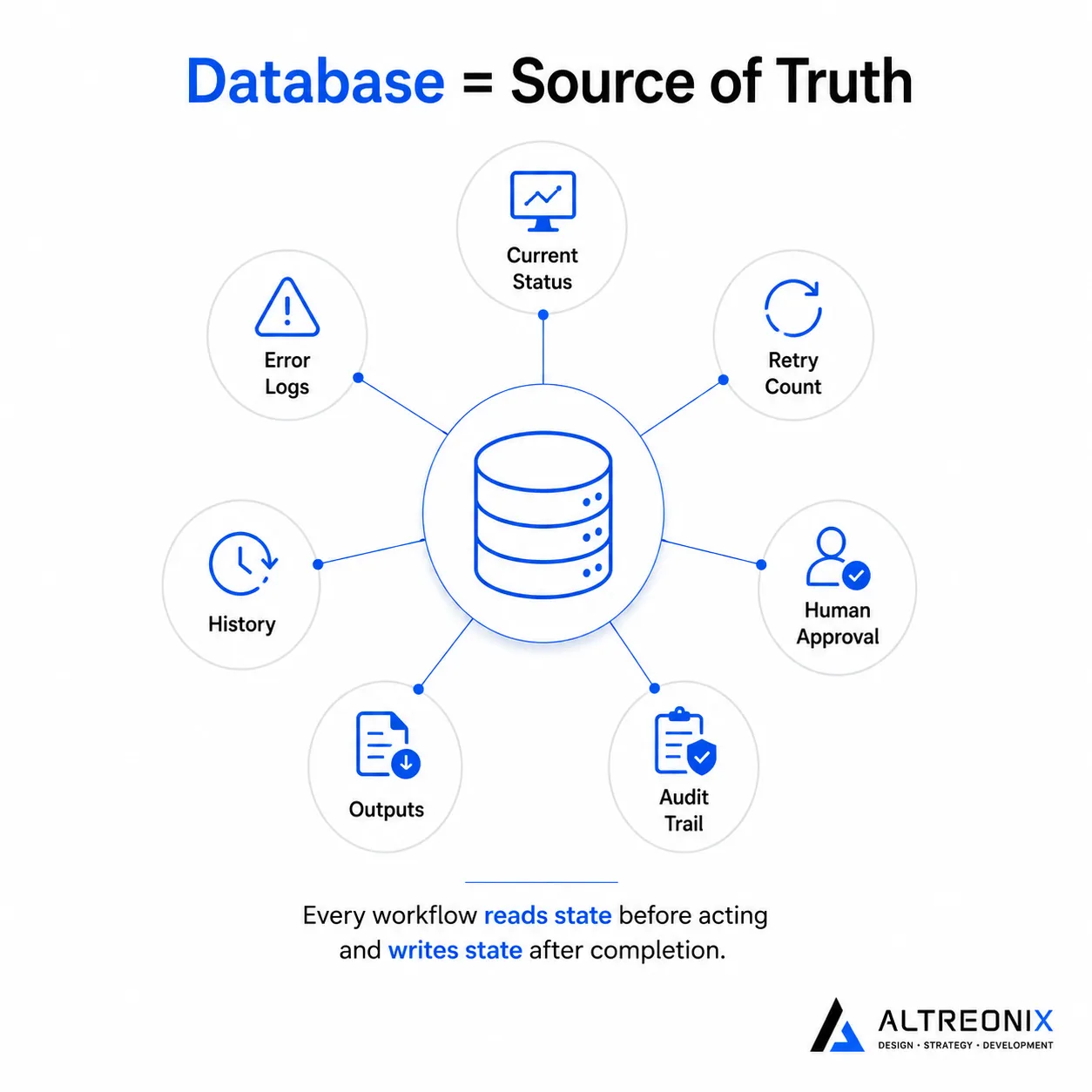
In a state-driven architecture, the database is not just storage. It is the memory of the system.
That means the system can answer questions like:
What step is this task currently on?
What failed, and when?
What has been approved?
What is waiting for a human decision?
What can be safely retried?
What is finished?
These are not exotic requirements. They are the baseline for any workflow that runs inside a real business. And they are easy to answer when state is in the database. They become detective work when state lives in a running process.
LangGraph's persistence design reflects this directly. The checkpointer saves a checkpoint of the graph state at each step, enabling session memory to store history and resume from a saved checkpoint, error recovery to continue from the last successful step checkpoint, and human-in-the-loop support to implement tool approval, wait for human input, and edit agent actions.
The database-as-truth model also makes debugging straightforward. When something goes wrong, the record shows exactly what happened and when. There is no need to reconstruct the execution history from logs or queue messages.
Why Process-Driven Agents Fail in Production
Memory Is Fragile
If an agent holds its context only in memory, a restart destroys the chain of execution. This is not an edge case. It is the default failure mode in any distributed system. Workers restart. Containers are replaced. Resources get recycled. An agent that cannot survive these events is not suitable for anything more than a single, uninterrupted task.
Recovery Becomes Guesswork
Without explicit state, recovery means reading logs, inspecting queue messages, and piecing together what the agent was doing at the moment of failure. This is slow and error-prone. Teams spend engineering time on reconstruction rather than on the actual work. The more steps an agent has, the worse this problem becomes.
Human Approvals Become Structural Problems
Once a human needs to approve a step, whether it is a tool call, a draft, a payment, or a decision, the system needs a clean pause and a clean resume. Without durable state, there is no boundary. The agent either cannot wait for the human, or it holds a live process open indefinitely, which is expensive and fragile.
LangGraph solves this with explicit interrupts. The interrupt function pauses graph execution and returns a value to the caller. When you call interrupt within a node, LangGraph saves the current graph state and waits for you to resume execution with input.
The OpenAI Agents SDK handles this through its RunState system. When a tool call requires approval, the SDK pauses the run, returns interruptions, and lets you resume later from the same RunState. That approval surface is run-wide, not limited to the current top-level agent.
Both approaches treat approval as a state transition, not an improvised pause in a live process. That is the only design that works reliably at scale.
The Connection to Automation Architecture
In our earlier post on event-based versus CRUD-based automation, we made the case that most business automation problems are really state management problems. The event that starts a process is less important than the state that tracks it through to completion.
AI agents fit this pattern exactly. The agent is just another layer in the workflow. It provides reasoning, tool use, and decision-making. But the system still needs a durable structure around it: a record that holds the current status, the history of transitions, the approval decisions, and the retry state.
The practical implication is that most multi-step AI workflows should be designed the same way we design CRUD-based automation. Start by defining the records. Define the valid states. Define what triggers each transition. Then add the language model as the component that decides what the next step should be.
The model does not replace the architecture. It fits inside it.
Real Business Workflows That Need State
Document and Content Pipelines
Drafting, review, revision, approval, and publishing are all state transitions. A document enters the system with a status of "submitted." It moves to "under review," then "approved" or "sent back for revision," then "published" or "archived." Each step can fail. Each step can be interrupted by a human decision.
An agent that handles this pipeline without persistent state cannot recover from a failure in the middle, cannot wait for a reviewer to return, and cannot tell an operator which documents are stuck.
Customer Support Automation
Support workflows typically move between an AI layer, a human agent, and backend systems. The system needs to know exactly where each case stands: what the agent said, what the customer replied, whether a human has been assigned, and what resolution was reached. That is a multi-step stateful workflow, not a single prompt.
Internal Approval Flows
A purchase request, a budget approval, a compliance review: all of these move through a sequence of human and automated steps. Each step is a status change. The system needs to pause while a person decides, resume when they do, and escalate if they do not. This is a textbook case for state-driven design.
Multi-Agent Coordination
When multiple agents work on the same task, each one needs to know what the others have done. A shared, durable state record gives every agent the same starting point, regardless of when it runs or which instance handles it. LangGraph provides comprehensive memory by creating stateful agents with both short-term working memory for ongoing reasoning and long-term memory across sessions.
Job Application and Recruiting Pipelines
A job application pipeline needs to know what was discovered, what was matched, what was sent, what was rejected, and what is waiting. That is persistent state across many steps and potentially many days. An agent working in this pipeline cannot hold all of that context in memory. It needs to read it from a record.
How to Design a State-Driven Agent at Altreonix
Step 1: Store the Job First
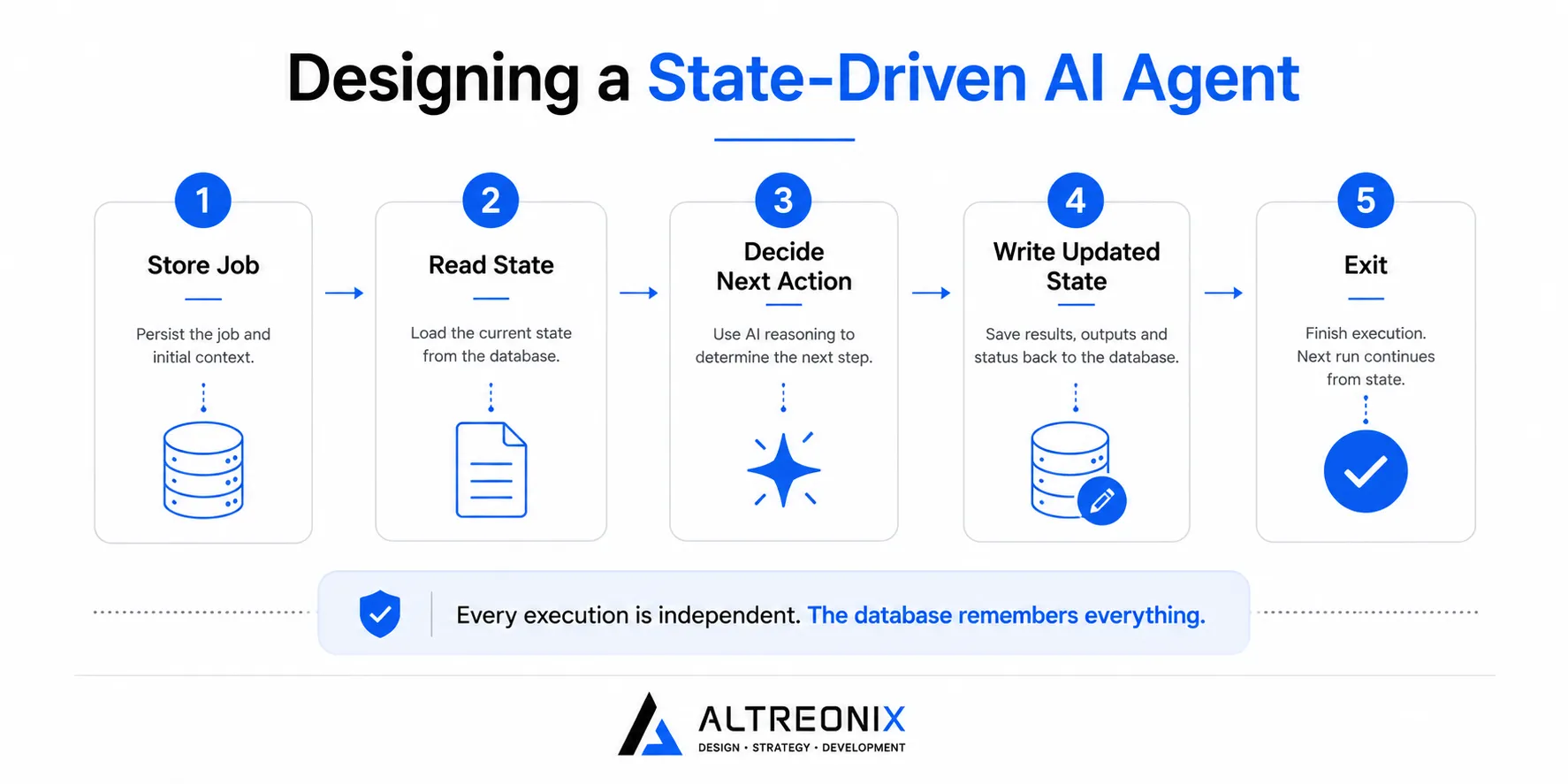
Every agent task begins as a record. Before the agent does anything, the task is written to the database. That record includes at minimum: a unique job ID, the current status, the current step, a retry count, an approval state, timestamps, and an output history.
This is not overhead. This is the architecture.
Step 2: Read State Before Acting
The agent reads the record before it does anything else. It does not guess what happened in a previous run. It reads the explicit state and works from there. If the status says the previous step failed, the agent retries it. If the status says the step is waiting for human approval, the agent does nothing until the approval comes through.
Step 3: Use the Model for the Next Decision Only
The language model's job is to decide the next useful step. It is not carrying the full history in its context window. The record already holds that. The model receives the current state, the relevant context, and a clear question: what should happen next?
This keeps the model focused and makes the decisions interpretable. If the model makes a bad choice, you can see the input it was given and understand why.
Step 4: Write Every Transition Back
Every meaningful transition updates the record. If a step completes, the status is updated. If an output is generated, it is stored. If a failure occurs, the failure is logged with a timestamp and a reason. This gives you a full audit trail, a resumable workflow, and a queryable status at any point.
Step 5: Exit Cleanly
The worker finishes the step and stops. It does not hold a connection open. It does not wait for the next step to arrive. Persistence comes from the database, not from a long-lived process. The next execution reads the updated record and continues.
For durable orchestration when runs may span long waits, retries, or process restarts, the major frameworks now offer integrations with workflow orchestrators that support exactly this model. The principle is the same whether you use a managed framework or build it yourself: the database holds the state, and the agent reads and writes it at each step.
Where This Architecture Fits Best
Internal tools with approvals. Any internal tool that routes work through a human approval step needs state. The approved or rejected status lives in the database, not in the agent's memory.
Content generation workflows. Generating a draft, reviewing it, revising it, and publishing it is a four-step stateful workflow. Each step needs to be tracked, retried if it fails, and visible to the team.
Data processing pipelines. When an agent processes records from a dataset, the state of each record (processed, failed, pending) should be in the database. This enables resumability and parallel processing without duplicated work.
AI-assisted business operations. Quote generation, invoice processing, contract review, report production: all of these are multi-step processes that require approval, retry, and visibility. State-driven design is the correct foundation for all of them.
Multi-step research and analysis tasks. When an agent is gathering information across multiple sources, synthesizing it, and producing a structured output, the intermediate results should be stored at each step. If the task is interrupted, the agent resumes from the last completed step rather than starting over.
Where Process-Driven Design Still Makes Sense
State-driven design is not the answer to every problem. There are genuine cases where a process-driven approach is correct.
If the primary job is to respond instantly to an external event, event-driven design is still the better choice. A fraud detection system that needs to decide in milliseconds cannot afford the overhead of reading and writing database records on every step.
If the system is processing a continuous stream of high-frequency events, such as a telemetry pipeline or a clickstream processor, a continuous process model is more appropriate. State-heavy orchestration would be too slow and too expensive.
If the agent's task is short and atomic, meaning it completes in seconds with no human input and no meaningful risk of failure mid-step, the overhead of building a full state machine is not justified.
This is consistent with our earlier post on automation models: event-based systems react well; CRUD-based systems remember well. Use each where it fits. Most production AI workflows need memory more than reaction speed.
The Real Advantage: Control
The case for state-driven agents is ultimately a case for control.
Visibility. You can look at the database at any time and see exactly what every job is doing, what step it is on, and what happened at each previous step. You do not need to read logs or trace events.
Debuggability. When something fails, the record tells you what the state was at the time of failure, what the agent was trying to do, and how many times it has already tried. That is a tractable debugging problem.
Resumability. A worker restart does not destroy progress. The next execution reads the stored state and continues from the last completed step. If your server restarts mid-conversation or a long-running workflow gets interrupted, it picks up exactly where it left off without losing context or forcing users to start over.
Auditability. Every important transition leaves a record. For regulated industries, compliance workflows, or any situation where someone might ask "what did the system do and when," a state-driven design gives you that history for free.
Human intervention. Approvals, overrides, and corrections are status changes in the database. They are not improvised interruptions to a live process. The system knows how to pause for a person and how to resume when the person responds.
These are not optional features for enterprise use cases. They are the baseline requirements for any system that runs inside a real business, handles real money, or affects real users.
Our Recommendation
Default to state-driven design for any agent task that spans more than one step.
If the workflow can fail mid-execution, it needs state. If a human might need to intervene, it needs state. If the task takes longer than a single synchronous API call, it needs state.
Keep the model focused on decisions. Let the database remember the journey. The model does not need to know everything that has happened. It needs to know what the current state is and what should happen next.
Use persistence deliberately, not as an afterthought. The checkpointing and state management features in LangGraph, the OpenAI Agents SDK, and AutoGen exist because production systems demand them. LangGraph is built for durable execution, streaming, human-in-the-loop support, and persistence because that is what it takes to ship agents that actually work in production.
Build approvals and retries as explicit state transitions. If a person can pause the flow or a failure can happen in the middle, the architecture should already know how to resume. Do not improvise these behaviors at the point of failure.
Final Thought
AI agents are not really about continuous intelligence. They are about durable progress.
A system that cannot remember where it stopped is not production-ready. A system that cannot resume from a failure is not reliable. A system that cannot show its current state is not manageable.
The frameworks that are gaining adoption in production environments have all arrived at the same conclusion: state is infrastructure, not a feature. LangGraph, the OpenAI Agents SDK, and AutoGen all treat persistence, resumability, and human-in-the-loop support as first-class concerns.
At Altreonix, we build AI systems the same way we build any other workflow: starting with the state model, not the trigger. The agent's intelligence matters. Its continuity matters more.